
Get in Touch

 (1).webp)
RFID technology enables businesses to automatically identify, track, and manage assets using radio waves.
Radio Frequency Identification (RFID) is a technology used to automatically identify and track objects through electromagnetic fields. An RFID system typically consists of RFID tags, RFID readers, and a host system or software. RFID tags contain a small microchip and antenna that store and transmit information. When an RFID reader sends radio-frequency signals, the tag responds by transferring its stored data to the reader. The host software then processes this information, allowing businesses to monitor, identify, and manage assets more efficiently. Unlike traditional barcode systems, RFID can identify multiple tagged items without requiring direct line-of-sight scanning. This makes it useful for applications where fast and automated tracking is required.
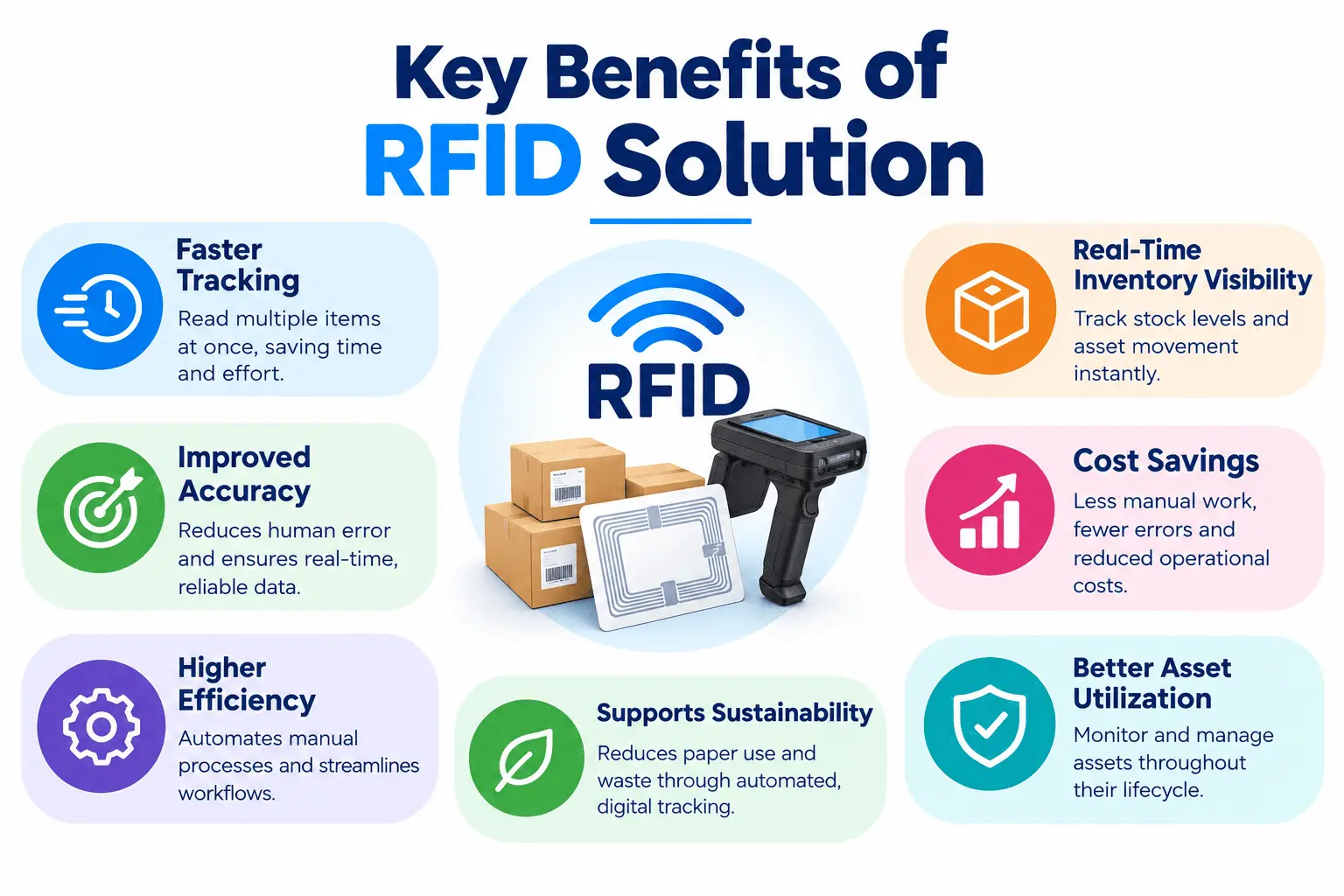
RFID technology helps businesses automate inventory, asset tracking, identification, and monitoring processes. A complete RFID solution can include RFID tags, fixed or handheld RFID readers, scanning devices, and dedicated software that collects and manages the data. With RFID, businesses can improve inventory visibility, perform stock counts faster, monitor asset movement, and receive alerts when inventory levels become low. It can also help identify unauthorized movement of tagged items and reduce losses caused by misplaced or untracked assets. RFID solutions are commonly used in retail, warehouses, libraries, healthcare, laundry services, logistics, manufacturing, and livestock management.

RFID technology helps businesses automate inventory, asset tracking, identification, and monitoring processes. A complete RFID solution can include RFID tags, fixed or handheld RFID readers, scanning devices, and dedicated software that collects and manages the data. With RFID, businesses can improve inventory visibility, perform stock counts faster, monitor asset movement, and receive alerts when inventory levels become low. It can also help identify unauthorized movement of tagged items and reduce losses caused by misplaced or untracked assets. RFID solutions are commonly used in retail, warehouses, libraries, healthcare, laundry services, logistics, manufacturing, and livestock management.
RFID technology is used across multiple industries to improve tracking, identification, inventory management, and operational efficiency. In retail, RFID helps businesses maintain accurate product information, perform faster stock counts, and improve inventory visibility. In libraries, RFID tags make it easier to manage books, automate check-in and check-out processes, and locate misplaced items. In healthcare, RFID can be used to track medicines, medical equipment, and other important assets, helping staff improve inventory visibility and locate items when needed. Laundry businesses can attach RFID tags to garments and linens to track items throughout collection, washing, sorting, and delivery. RFID is also useful in logistics and supply chain management, where tagged goods can be identified and tracked at different stages of transportation and storage. In livestock management, RFID ear tags help identify individual animals and maintain useful records related to movement, feeding, breeding, and herd management.



.webp)